
Is there meaning to the life of a startup if it ends with its exit through disintegration rather than an acquisition or Initial Public Offering (IPO)?
Like most events with winners and losers, the answer depends on whom you ask.
‘Reverse acquihires’ have quickly become the favored model for tech companies that acquire only some parts of an AI startup, namely the key talent and occasionally, some technology.
These deals are problematic for multiple reasons. For the startup, now a vestige of its former self, the rank-and-file employees left behind have to begin from square one again. No windfall exit gains for them! Venture capitalists and other investors get some returns but not as much as when a startup exits via an IPO or a traditional acquisition. Often, the startup ends up pivoting in a less ambitious business direction or shutting down.
As for the reverse acquirer, one of its goals is to bypass regulation that typically kicks in during mergers and acquisitions of a certain size and character.
Clearly, these are uncomfortable truths. We can continue the age-old debate about the (un)fairness of capitalism. But, there’s no time for that. The AI race is on and it’s fierce.
Are speed and competition an excuse to break things? Certainly not. And pretty much every article covering this topic in the media points that out.
Just for argument sake, I decided to take a contrarian view to write this article. I put myself in the shoes of the ‘reverse’ acquiring tech companies which are currently deep in the throes of the AI arms race. If speed and battling the competition are their priority, reverse acquihires or some version thereof, might be the only way for tech companies to scale quickly with AI. Or they risk falling behind.
Through that lens and with judgement set aside for just a moment, I discuss the reasons why reverse acquihires make sense right now and what the AI hiring landscape could look like once the dust settles.
The theory and practice of reverse acquihires
If you hadn’t heard the term ‘reverse acquihire’ prior to 2024, you are in the majority. Its origin can be traced back to mid 2024 when tech giants Amazon, Google and Microsoft partially acquired certain AI startups.

The word ‘acquihires’ (sans ‘reverse’) has actually been around for a couple of decades or longer to refer to deals in which struggling companies are acquired primarily for the talent (hence the word ‘hire’ in the name). In typical acquihires, due to the poor performing nature of the business, the acquirer can get the talent (and occasionally other assets or capabilities) for a lower price.
‘Reverse’ acquihires occur when the typical acquihire model is flipped. Purchasers acquire talent or license technology from high performing or promising companies and usually pay premium prices. By doing so, they bypass the regulatory issues that arise during traditional full-company, high-priced acquisitions.
Just to seal the definitions discussion, in traditional acquisitions (that are neither characterized as acquihires or reverse acquihires), the buying company acquires the target to get access to its products or services, talent, customer list, brand, property and everything else. Like the time in 2014 when Facebook bought all of WhatsApp including its 450 million Monthly Active Users (MAUs) at the time for $19 billion.
Selected examples of recent AI reverse acquihires
As one of the first examples of a reverse acquihire, in March 2024, Microsoft absorbed most of the employees from Inflection AI to start its own consumer AI unit. It also paid $650 million to license Inflection’s technology. Inflection, which until then had been developing multiple AI products, decided to pivot to merely licensing its technology to other enterprises once its leadership team left.
In June 2024, Amazon hired most of Adept AI’s staff and paid $330 million to license its technology. Some of Adept’s employees stayed back in the startup to manage the licensing business. However, after the brain drain, Adept was no longer in the same business that it started with.
In August 2024 Google considered fully acquiring Character AI. Eventually, it settled on just licensing its technology for $2.7 billion and poaching its co-founders and other executives. Character AI is still in business as a separate, independent company.
These initial reverse acquihires, in comparison to the recent spate in mid-2025, can be considered a good deal. All three companies were starting to struggle and putting themselves up for sale seemed like the best outcome.
Adept, for example, was valued at $1 billion in 2023 but had lost some steam by the time Amazon hired its staff in 2024. Inflection was once valued at $4 billion and building its own AI foundation models. But the costs of scaling had disempowered it, signaling a shaky future.
Repaying the Investors
In each of these reverse acquihires, the buying (or poaching) company paid a licensing or other fee to the target company. The payment also provided an opportunity for the startup to pay its investors.
In most cases, venture capitalist and investor return on investment wasn’t as high as it would have been with a traditional startup exit. When Microsoft reverse acquihired Inflection, investors were returned 1.1 to 1.5 times their investment, a far cry from the desired 10x+ for early stage investments. Certainly not how much you would expect to get from a startup that was valued at $4 billion barely a year ago.
In the previous three examples, the reverse acquihire model of acquisition was used once the possibility of an outright acquisition dimmed for various reasons. They weren’t initially intended to be pure talent grabs.
At some point soon after, Amazon, Google, Microsoft and their tech rivals noted the merit of using reverse acquihires. From then on, we have seen it emerge as a way for the acquiring companies to have their cake and eat it too. Here are some examples.
Meta paid $14 billion for a stake in Scale AI to entice its CEO Alexandr Wang to lead Meta’s newly created Superintelligence unit. This led OpenAI and Google to end their contracts with Scale AI which also let go of 14% of its remaining workforce. Evidently, the move was a big hit to Scale AI’s current and future earnings.
What is fascinating is that it isn’t only Big Tech that is resorting to reverse acquihires. Fast growing startups are also using them to compete on more solid ground, especially in the enterprise space where their reach is limited. Here are some examples.
OpenAI (well…..it’s still considered a startup albeit a mature one by now) almost bought all of Windsurf for $3 billion. The plan fell through either due to the role played by Microsoft, a key investor and partner of OpenAI or because Windsurf was trying to push more for OpenAI to invest in it. We don’t quite know the exact reason.
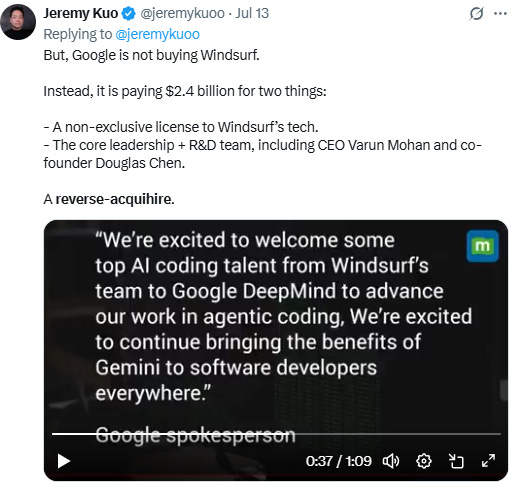
But, soon after, it was announced that Windsurf’s leadership team and some AI researchers/engineers had moved to Google which offered $2.4 billion to license its technology. The rest of the company was swallowed up by AI coding startup Cognition for a small fraction of what OpenAI would have paid.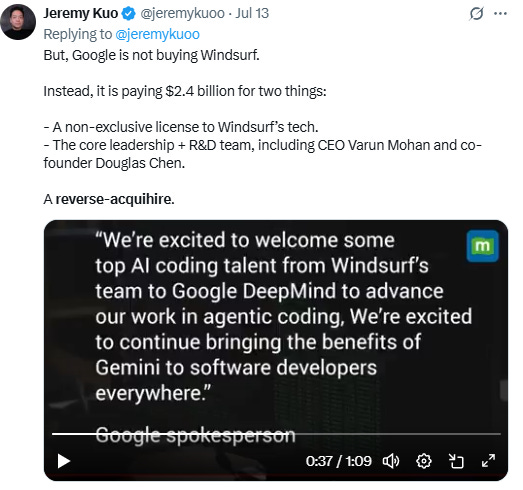
In July 2025, AI coding startup Cursor’s parent Anysphere bought a startup called Koala. Not all of it. Just its top engineers! Unfortunately, in this case, the four-year old, AI-based CRM startup Koala is shutting down its operations in spite of recently raising funds to continue operations.
In August 2025, Anthropic brought on most of the team at Humanloop, a prompt management platform. None of the other assets or capabilities were acquired by Anthropic.
Why reverse acquihires might be the only way
……for now. It won’t be the only way for too long. Especially as regulators start cracking down on them. But, at this stage in the AI race, they seem to be the optimal strategy for the acquiring companies. Here are some reasons why.
1. This AI race is different from previous tech wars
The unfolding AI saga is different. Every big tech company is highly motivated to dominate. And that is putting it mildly.
Many articles that discuss competition in the AI sub-industry refer to it as an ‘AI arms race’. It definitely resembles one.
In military parlance, an ‘arms race’ refers to a competitive buildup of military weapons between nations or groups. Each side continuously escalates its capabilities in response to the other's strategies.
In today’s AI world, there is intense competition between the Big Tech companies to develop the most advanced artificial intelligence capabilities such as AGI and Superintelligence.
AGI as “Artificial general intelligence (AGI) is a hypothetical stage in the development of machine learning (ML) in which an artificial intelligence (AI) system can match or exceed the cognitive abilities of human beings across any task. It represents the fundamental, abstract goal of AI development: the artificial replication of human intelligence in a machine or software.”
Artificial Superintelligence as “Artificial superintelligence (ASI) is a hypothetical software-based artificial intelligence (AI) system with an intellectual scope beyond human intelligence. At the most fundamental level, this superintelligent AI has cutting-edge cognitive functions and highly developed thinking skills more advanced than any human.”
Their underlying belief is that the winner will take all. And whoever gets to AGI first also gets the first mover advantage of potentially controlling the foundation technology and the next computing platform entirely.
It’s quite the prize. Hence, it’s quite the race!
The release of advanced Generative AI and Large Language Models (LLMs) in 2022 intensified the competition as this technology not only became accessible to everyone but also that individual users and enterprises saw the immense opportunities to change their lives with it.
Almost everyone by now recognizes that if we combined the cognitive capabilities of a human with the speed, memory, reliability, and scalability of high-performance computing, every human would become superhuman and who doesn’t like that idea! Businesses, in particular, would achieve much more productivity with fewer resources and lower costs. Profits are then likely to follow.
Competition for resources and capabilities to develop AGI is at its highest
The convergence of multiple factors, the combination of compressed timelines, massive resource requirements, scarce talent, and both corporate and national security implications make this competition uniquely intense compared to past tech battles like the mobile platform wars or search engine competition.
Slowing down for any of these ambitious tech athletes would mean falling behind in the AI race. They also need to achieve the intermediate goals toward AGI such as market leadership in AI applications (search, productivity, agentic tasks), control over data access and of course, getting the best talent on board to help achieve them.
Once they achieve a milestone, the need of the hour is to scale quickly before a competitor catches up and grabs market share. Tech companies are being proactive but also extremely reactive to a competitor’s move, which catalyzes all actions.
In reality, this race is also between nations, particularly the United States and China. But, that is the focus of a different article.
2. Reverse acquihires are easier than risking the slow and unpredictable regulatory process
…especially if you don’t want anything else from the target.
A key reason why reverse acquihires have become popular in recent months is that this format allows the acquirer to avoid the slow and unpredictable regulatory process.
Take the example of Adobe and Figma. In 2022, the two companies reached an agreement for Adobe to fully acquire Figma for $20 billion. After a year of a regulatory, anti-trust review, the deal had to be called off in December 2023. In this case, it was the European regulatory bodies that had deeper concerns that the U.S.
Back on point, the Biden administration, which was in the White House when the first three reverse acquihires took place, had started scrutinizing them and becoming more stringent with technology deals. Until then, startup acquisitions were not on the radar as much.
According to a research paper on alternative forms of exits, “Between 2012 and 2019, enforcers challenged only three startup acquisitions. Between 2020 and 2023, they challenged fourteen. Lawsuits or the credible threat of lawsuits killed deals between Adobe and Figma (design software), Sanofi and Maze (pharmaceuticals), Qualcomm and Autotalks (automotive), and Google and Wiz (cybersecurity). The chilling effect spread across Silicon Valley, putting would-be acquirers, founders, and VCs on notice that acquisitions by large incumbents were risky.”
This regulatory concern gave rise to creative new forms of making acquisitions; in some ways a better one. Reverse acquires offered an optimal way to get the talent, access to the technology and avoid the regulatory process. It also allowed companies NOT to buy the parts they didn’t want.
In 2025, reverse acquihires have only increased in number and payouts. European regulatory agencies have already put in rules that reverse acquihires are ‘reportable transactions’ that will undergo review. In the United States, although the Federal Trade Commission and the Department of Justice’s Anti-Trust division under the Trump administration have not taken action as yet on reverse acquihires, they are watching and asking questions. It is only a matter of time before they ask many more.

3. The time and price is right
Given the competitive dynamics related to AI, the right time to acquire talent, is as soon as you spot it. Because if your company does not bring them on, your competitor will.
That is exactly what happened with the OpenAI - Windsurf - Google case. When OpenAI’s acquisition process for Windsurf slowed down, Google swept in and hired Windsurf’s leadership team overnight. By that point, Windsurf was on the industry radar as a prime candidate. If not Google, it would have been one of the other tech companies. There are dual goals here; acquiring talent but also neutering competition in one fell swoop!
If you start doing the salary math at any point, it would be natural to wonder why Google would pay $2.4 billion just to hire a few people from Windsurf. That is another trend that differentiates the AI race from any others in the past. Companies are willing to pay outrageous amounts to recruit talent. According to many reports, Mark Zuckerberg personally approached star AI founders or operators and offered some of them 100s of millions of dollars in compensation to join Meta.
Which brings me to the point that the price for talent in dollar terms is ridiculously high. But, the hiring companies don’t seem to blink at it because their focus is on how quickly that will help them move forward toward AGI. Presumably, it would be higher if they bought the entire company outright. So, the price, regardless of what it is, is right.
To sum it up,
IF you were in an intense AI arms race battling hyper-competitive, well-endowed rivals; and
You wanted to fill the talent gaps in your arsenal; and
You wanted to avoid regulatory reviews which would slow you down; and
You were willing and able to pay a high price to get what you want; and
A reverse acquihire were the easier solution that checked the above four boxes, would you go for it?
That might make sense for an acquiring company. But,…..
Why would talent go from being a big fish in a small pond to a small fish in a big pond?
In other words, why would talented founders and star researchers leave their prestigious position to become just another employee in a large, tech company?
As some of those founders discovered that after some initial success, building foundation models or coding platforms is costly. Startups don’t have the technical infrastructure that can support them. They create it as scale, often after raising and spending more money.
Although the plans starting out might have been promising, the reality of building startups in capital-intensive areas like AI is much more about navigating pitfalls.
Finding a buyer willing to pay a high price for a startup that is only half baked (or still baking) can also be difficult. So, why not accept a good offer from a larger company where access to funds is easier, the infrastructure already exists and you get to continue to work on the same or similar problems as your original startup! Why then wouldn’t you pick the cushier life after having tried the harder one?
What the AI hiring landscape will look like when the deal-making dust settles
An article in the Wall Street Journal (WSJ) published yesterday reported that Meta has now frozen hiring for its AI workforce. They had already hired ~50 AI experts using various means including reverse acquihires. Hard to say how long the freeze will last. If I were to predict, it would be until a competitor makes a move that feels threatening. Tis the way things seem to be happening in this industry right now. Many proactive actions but an equal number of reactive ones.
At some point, the hiring frenzy will abate. According to another article in WSJ titled ‘Big Tech Is Eating Itself in Talent War’, the writer suggests that startup culture itself might get eroded if the current hiring patterns continue.
“If the reverse acquihire trend persists, there is a reasonable chance many people who would have been bold enough to join a risky startup will give more weight to their other options. They might instead go directly to big tech companies, in what might be a safer route for themselves but one that makes the pool of available startup talent shallower.”
Although that article sounds reasonable, I might not go that far. First, I don’t think this trend will persist beyond 2026 although several other articles seem to believe that.
Regulators will eventually act and get in the way. Sure, they haven’t had a great track record of regulating the technology industry in the past. And yes, the current administration is seen as being more pro-business than the previous one. Even so, the Trump administration is moving forward with the antitrust cases against Google, Amazon and some others. They could start cracking down on reverse acquihires at any point if the trend continues.
Regardless of whether it persists or not, I agree that some people will try to go directly to big companies. But, not because joining startups will seem risky due to reverse acquihires, as the article contends. People join startups for many reasons and job security isn’t top on the list. It will be because Big Tech is best situated to ‘win’ the AI race compared with any startup out there.
Big Tech has the resources, the infrastructure and their eggs are not all in the AGI basket. Each of them has other businesses that drive revenue, whether it is Google, Meta, Amazon or Microsoft. They will continue to be sought after as desirable places for those who want to put their fingerprints on AI, regardless of the reverse acquihires trend.
That also means consolidation of talent and AI technology in the hands of a few. With that, we have come the full circle back to the starting point and yet another uncomfortable truth.
If you enjoyed this article or learned something new, please do share it with others. I would greatly appreciate it!